Electrical steel processing affects both dimensional accuracy and magnetic performance. Slitting establishes strip width, stamping creates lamination geometry, and heat treatment may be used to develop or recover the properties required by the application.
These operations should not be treated as a fixed sequence for every grade. Fully processed and semi-processed materials have different heat-treatment requirements. Grain-oriented steel also needs special attention to rolling direction, coatings and any domain-refinement treatment.
Stress-relief annealing is a type of annealing used to reduce processing-induced stress. It is not automatically an additional step after every other annealing operation.
Table of Contents
Toggle
Start with the Material Grade and Delivery Condition
Grain-Oriented and Non-Oriented Electrical Steel
Grain-oriented electrical steel, or CRGO, has strongly directional magnetic properties. Transformer lamination layouts should account for the rolling direction and intended magnetic flux path.
Non-oriented electrical steel, or CRNGO, is commonly used for motor and generator laminations where magnetic flux changes direction. Its properties are less directional than CRGO, although processing and test direction still matter.
Fully Processed and Semi-Processed Material
For non-oriented electrical steel, confirm whether the supplied material is fully processed or semi-processed. This distinction determines whether customer-side final annealing forms part of the intended manufacturing route.
Material condition
Processing implication
Fully processed non-oriented steel
Final magnetic properties are developed before delivery. Additional heat treatment is not automatically required after stamping.
Semi-processed non-oriented steel
Customer-side final annealing is part of the intended route for developing the specified magnetic properties.
Grain-oriented steel
Confirm the permitted downstream treatment for the exact grade, coating and domain-refinement condition.
Record the material grade, thickness, coating designation and delivery condition before setting the processing route. A familiar grade family name alone is not enough to define furnace settings or tooling requirements.
Electrical Steel Slitting: Control the Edge and Strip Shape
Width, Camber and Winding Quality
Slitting converts a wider coil into strips suitable for subsequent cutting, stamping or core winding. Buyers should specify width tolerance, camber, coil dimensions, winding condition and any required edge-quality limits.
Blade condition, knife setup and strip tension influence the result. The setup should be qualified for the actual material thickness and grade rather than copied from a different product.
When ordering slit CRGO coils and strips, also confirm coil identification and rolling-direction traceability.
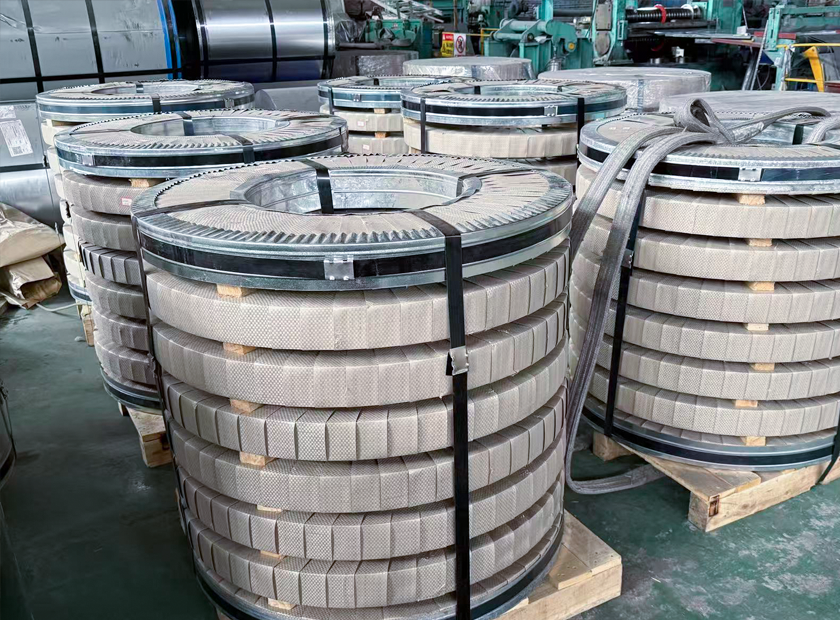
Slit coils prepared for handling and downstream processing.
Burrs, Coating Damage and Residual Stress
Slitting creates a mechanically affected region at the cut edge. Excessive deformation can worsen magnetic performance, while burrs may create unwanted electrical contact between laminations in an assembled core.
Inspect edge condition and coating integrity as well as strip width. Scratches, loose winding and damaged edges can create problems during later operations even when the nominal dimensions are correct.
Do not assume that subsequent annealing will compensate for poor slitting. Heat treatment cannot restore missing metal, remove an excessive burr or repair every form of coating damage.
Electrical Steel Stamping: Protect Geometry and Magnetic Performance
Qualify the Tooling and Cutting Conditions
Stamping produces the slots, teeth and profiles required for laminations. Die clearance, tool wear, alignment and material support influence burr formation and deformation around the cut edge.
Narrow teeth and bridges can be particularly sensitive because a larger proportion of their section lies close to a processed edge. Check representative production laminations rather than relying only on the incoming coil certificate.
Use tooling trials to establish an acceptable operating window. There is no single clearance or press speed suitable for every thickness, grade and lamination design.
Control Lubrication and Stack Assembly
Any lubricant or cleaning process should be compatible with the insulation coating and later manufacturing steps. Residues can affect bonding or heat treatment.
Interlocking, welding, bonding and mechanical clamping introduce different assembly conditions. Confirm the proposed method during material selection, particularly if the laminations or assembled stack will receive further heat treatment.
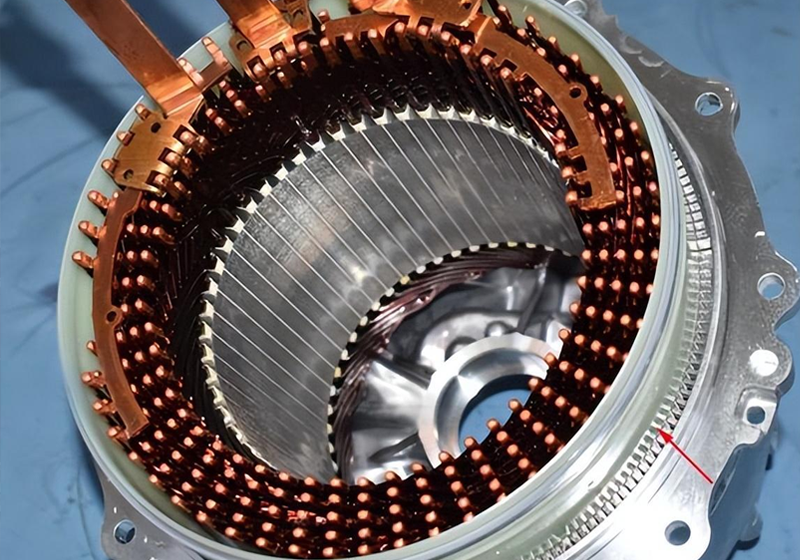
Application example: electrical steel laminations in a motor assembly.
Annealing and Stress Relief: Confirm the Purpose Before Heating
Final Annealing Develops the Required Material Condition
Semi-processed non-oriented steel requires a defined final-annealing route. Depending on the product, this treatment can involve microstructural development and decarburization, rather than stress reduction alone.
Cutting, forming and handling can introduce stress that affects magnetic properties. Where the material permits it, stress-relief annealing may reduce this contribution to loss.
The benefit must be checked against coating compatibility and the complete manufacturing route. Further forming or unsuitable assembly conditions can introduce stress again after annealing.
Laser-domain-refined CRGO needs particular attention. Some treatments are not heat resistant, and subsequent annealing can reduce their magnetic benefit. Thyssenkrupp's grain-oriented steel processing guidance describes this limitation for its laser-treated material.
Qualify the Furnace Cycle and Coating Together
Temperature, holding time, atmosphere, heating rate and cooling conditions must be defined for the grade and load. Coating type, lubricant residues, part geometry and furnace uniformity also need consideration.
A coating designation alone does not establish compatibility with every furnace cycle. Confirm the coating supplier's permitted conditions, including any bonding or assembly restrictions.
This guide does not prescribe a universal annealing temperature or atmosphere. The appropriate cycle must come from material-specific instructions and process validation.
Verify the Finished Processing Route
Retain traceability from the incoming coil through slitting, stamping and any heat treatment. Record dimensional results, edge condition, coating checks and the applied furnace cycle where relevant.
For magnetic comparisons, use defined sample preparation, test methods, frequency and flux-density conditions. A material certificate and a finished-core measurement should not be treated as directly equivalent tests.
1. Does all electrical steel need annealing after stamping?
No. Fully processed non-oriented steel is commonly used without customer-side final annealing. Semi-processed material has a different route, while optional stress relief depends on the grade and application.
2. Can annealing remove stamping burrs?
No. Burr control depends on cutting conditions, tooling and any qualified finishing process. Annealing should not be used as a substitute for acceptable edge quality.
3. Can the same heat-treatment cycle be used for CRGO and CRNGO?
Do not assume so. Their structures, coatings and processing purposes differ. Confirm instructions for the exact material, including whether any domain-refinement treatment tolerates heat.
4. Why can core loss increase after slitting or stamping?
Processing can introduce deformation and residual stress near cut edges. Burrs, coating damage and assembly conditions may also affect the completed core. There is no universal percentage increase for every design.
5. What information should I provide when ordering electrical steel for processing?
Provide the application, grade or performance target, thickness, strip dimensions, coating, delivery condition, cutting method, assembly process and any planned heat treatment.
Discuss Your Electrical Steel Processing Requirements
Planning the material and downstream process together helps avoid incompatible coatings, unnecessary heat treatment and unclear acceptance requirements.
Contact SHERAXIN with your core application, material specification, slit-strip dimensions and planned processing route to discuss suitable electrical steel supply options.