Selecting electrical steel for high-efficiency motors requires more than choosing the lowest core-loss figure in a catalog. Motor designers must balance magnetic performance, lamination thickness, mechanical strength and manufacturing conditions against the efficiency target of the complete motor.
IE3, IE4 and IE5 describe motor efficiency classes. They do not specify a universal electrical steel grade. A material that works well in one motor may be unsuitable for another with a different speed, geometry, cooling system or supply waveform.
This guide explains how to translate an efficiency target into practical material requirements, what to request from a supplier and how to verify performance after processing.
Table of Contents
Toggle
What IE3, IE4 and IE5 Mean for Electrical Steel Selection
IEC 60034-30-1:2025 defines efficiency classes for line-operated AC motors within its scope and introduces IE5. The applicable efficiency limit depends on factors including rated output, pole count and supply frequency.
For variable-speed motors outside that scope, IEC TS 60034-30-2:2016 provides a separate classification framework. Identify the applicable standard, edition and test method before specifying materials.
A higher efficiency target tightens the allowable total loss budget. Electrical steel affects core losses, but motor efficiency also depends on winding losses, rotor losses, mechanical losses and other design factors.
Efficiency Target
Material Selection Focus
What to Avoid
IE3
Select material that meets the core-loss allocation while maintaining suitable magnetic properties and production economics.
Assuming any standard non-oriented grade will achieve the target.
IE4
Review whether lower losses, different thickness or improved processing are needed within the complete motor design.
Assigning one mandatory sheet thickness to all IE4 motors.
IE5
Evaluate material, motor topology and manufacturing together against the required loss budget.
Treating a steel grade or material certificate as proof of IE5 motor efficiency.
There is no reliable conversion table stating that a particular grade automatically produces an IE3, IE4 or IE5 motor. Qualification must connect material data with the actual motor design and test results.
Which Electrical Steel Properties Matter Most?
Non-Oriented Steel for Motor Laminations
Non-oriented electrical steel is widely used in motor laminations because magnetic flux travels through different directions within the core. Its magnetic properties are more suitable for this duty than those of grain-oriented steel optimized for a preferred rolling direction.
However, non-oriented steel is not perfectly identical in every direction. Where directional behavior matters, request relevant magnetic data rather than relying only on the material category.
Sheraxin lists cold-rolled non-grain-oriented electrical steel. Use the published product information as an initial reference, then confirm the required grade, thickness, coating and delivery condition for the motor project.
Core Loss at Relevant Operating Conditions
A catalog loss value is meaningful only with its test conditions. For example, P1.5/50 indicates specific total loss measured at a peak magnetic polarization of 1.5 T and a frequency of 50 Hz. It is not a prediction of finished motor losses at every speed or supply condition.
For inverter-fed or higher-frequency applications, request loss data covering the relevant frequency and magnetic operating range. A single sinusoidal test point cannot fully describe the effects of inverter harmonics or rotating flux.
Compare candidate materials under matching test conditions. Lower loss at one operating point does not necessarily mean lower loss throughout the motor duty cycle.
Magnetic Polarization and Magnetizing Demand
Low core loss should be considered alongside the material’s magnetic response. Review magnetization curves to understand the field required to reach the intended operating point.
A design operating close to magnetic saturation may experience increased magnetizing demand and local heating. A catalog polarization value measured at one specified field strength should not be treated as the saturation limit of the material.
Lamination Thickness and Mechanical Requirements
Thinner laminations can reduce the classical eddy-current component of core loss, particularly as frequency increases. However, total core loss includes other components, and the benefit depends on the material and operating conditions.
As discussed in this electrical steel thickness selection guide, thickness also affects stamping, production capacity and cost. Thinner material is not automatically the best overall choice.
Rotor laminations may also require specific mechanical properties, especially at high speed or around narrow bridges and other stressed features. Evaluate the stator and rotor separately before deciding whether both should use the same grade.
How Processing Changes Electrical Steel Performance
The magnetic properties of incoming strip do not fully represent the performance of an assembled motor core. Slitting, punching, joining and assembly can change the result.
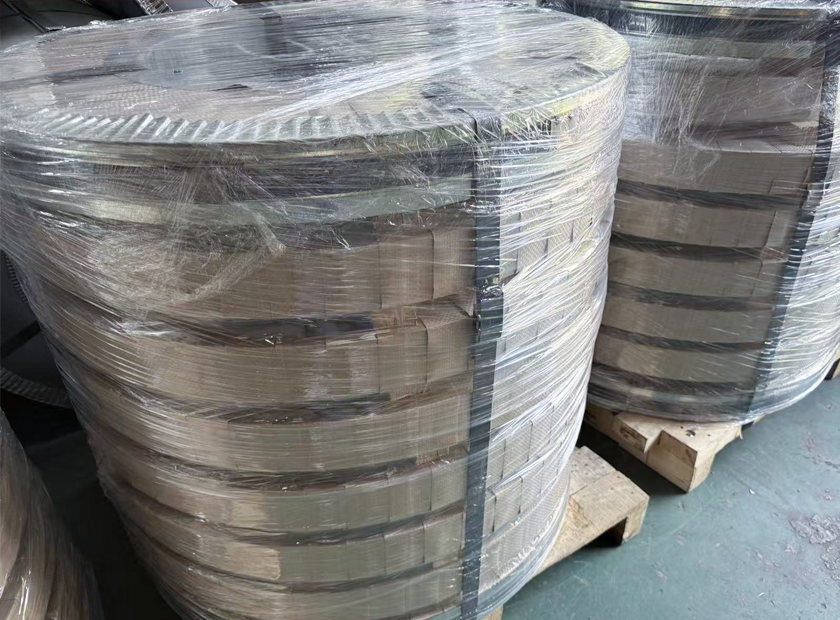
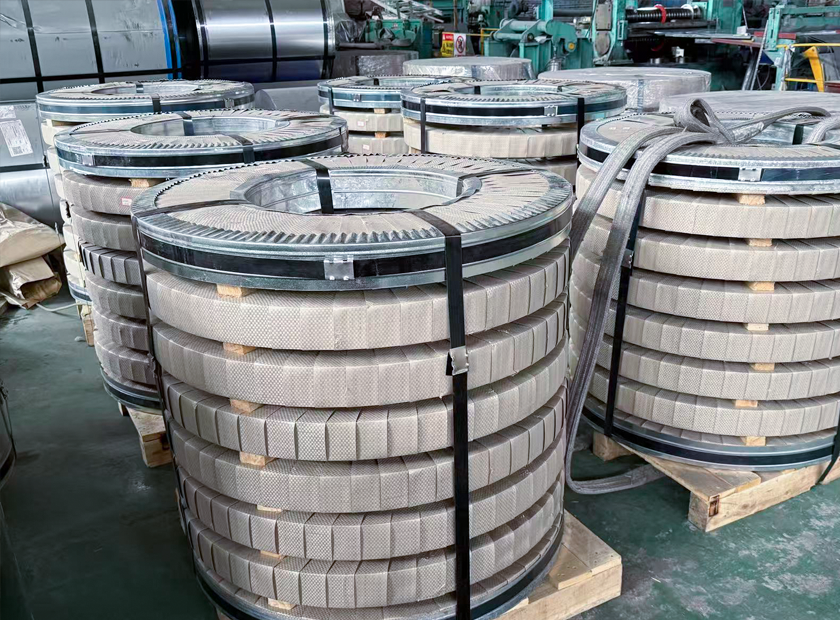
Coil handling and strip preparation form part of the manufacturing route. The photograph does not identify a specific motor grade.
Slitting, Punching and Burr Control
Cutting introduces deformation and residual stress near the edges of laminations. This can change magnetic behavior, particularly in narrow teeth and other small features.
Excessive burrs can also create unwanted electrical contact between laminations. Specify edge quality, dimensional tolerances and inspection methods with the processor rather than assuming that a good incoming loss value guarantees a good finished core.
Interlaminar insulation helps limit unwanted current flow between sheets. The coating must also suit the intended stamping, stacking and joining process.
Coating thickness affects the proportion of magnetic steel within a fixed stack height. Welding, interlocking and other assembly methods can introduce local stress or electrical connections between sheets. Evaluate these effects in the actual core construction.
Annealing Compatibility
Do not assume every motor lamination needs the same annealing treatment. Fully processed and semi-processed materials have different intended processing routes.
If the manufacturing plan includes stress-relief or final annealing, confirm the grade-specific treatment and coating compatibility with the material supplier. An unsuitable cycle may damage the coating or alter the expected properties.
How to Specify and Qualify Electrical Steel for Motors
Start with the Motor Loss Budget
Estimate how much loss the design can allocate to the magnetic core after accounting for the other motor losses. This creates a clearer selection target than requesting “IE5 steel” without supporting design information.
Then compare candidate materials using magnetic data relevant to the motor’s operating range. Where the application has several important operating points, assess the duty cycle rather than optimizing only one condition.
Send a Complete Material Requirement
Information to Provide
Why It Matters
Motor type, output, speed range and supply
Defines the operating conditions and relevant material comparisons.
Target efficiency class and applicable standard
Connects material selection with the complete motor qualification plan.
Thickness, tolerance, strip width and delivery format
Allows the supplier to assess availability and processing requirements.
Required loss data and magnetization curves
Supports comparison under defined magnetic conditions.
Coating, joining method and annealing route
Helps check compatibility throughout core manufacturing.
Mechanical requirements and acceptance documents
Clarifies rotor constraints, inspection and batch traceability expectations.
Specify the required strip dimensions, delivery condition and packaging when requesting a quotation.
Validate After Processing and Assembly
Use material certificates to verify agreed incoming properties, then evaluate representative laminations or cores produced through the intended manufacturing route. Finally, test the complete motor using the applicable efficiency measurement procedure.
Sheraxin’s technology and quality information provides a starting point for discussing inspection. Confirm which measurements, documents and batch controls are included in the specific order.
Compare total production cost as well as material price. Scrap rate, tooling, processing time, stack construction and the resulting motor performance can all affect the value of a material change.
Frequently Asked Questions
1. Is there an IE4 or IE5 electrical steel grade?
IE4 and IE5 are motor efficiency classes. They are not electrical steel grade designations. Select steel against defined magnetic, mechanical and processing requirements, then verify the complete motor.
2. Does an IE5 motor always need thinner laminations?
No universal lamination thickness applies to every IE5 motor. Thickness selection depends on frequency, motor design, loss allocation and production constraints.
3. Is a 50 Hz core-loss value enough for an inverter-fed motor?
It can be useful for an initial comparison, but it is insufficient to characterize the full operating range. Request relevant frequency-dependent data and evaluate the effects of the actual supply waveform.
4. Can the stator and rotor use the same electrical steel?
They can in some designs. Other motors need different materials because stator loss requirements and rotor mechanical stresses differ. Confirm both sets of requirements before standardizing the grade.
5. Can better electrical steel upgrade an IE3 motor to IE5?
A material change may reduce core losses, but it does not guarantee a higher efficiency class. The result depends on the complete motor design, manufacturing process and measured efficiency.
Discuss Electrical Steel Requirements for Your Motor Project
Preparing an IE3, IE4 or IE5 motor project? Share your motor type, operating range, required strip dimensions and magnetic performance targets with Sheraxin. Ask for available CRNGO grades, coating options, delivery conditions and supporting material data before selecting material for a production trial.