Electrical steel coatings help separate adjacent laminations electrically, but their role extends beyond insulation. The selected coating also influences how the material behaves during punching, welding, heat treatment and storage.
A coating suitable for one manufacturing route may be unsuitable for another. High insulation resistance does not automatically establish good weldability, annealing compatibility or corrosion protection.
Electrical steel cores use thin laminations to limit eddy-current losses. An insulating surface layer helps prevent adjacent sheets from forming unwanted conductive paths through the stack.
This is interlaminar insulation. It should not be treated as a replacement for the separate insulation required between windings, the core and other transformer or motor components.
Coating continuity matters as well as the measured insulation value. Scratches, excessive burrs and local damage can create electrical contact even when an undamaged sample performs well.
Why Coating Thickness Is a Trade-Off
Coating formulation and thickness influence insulation performance, adhesion and processing behaviour. Increasing thickness is not automatically the best solution.
Additional coating occupies space within the lamination stack. For a given stack size, this can reduce the proportion of active steel. Buyers should therefore consider insulation requirements alongside stacking factor and dimensional limits.
Specify whether thickness refers to one coated side or the combined coating on both sides. Also confirm the test method and conditions used for reported surface insulation values.
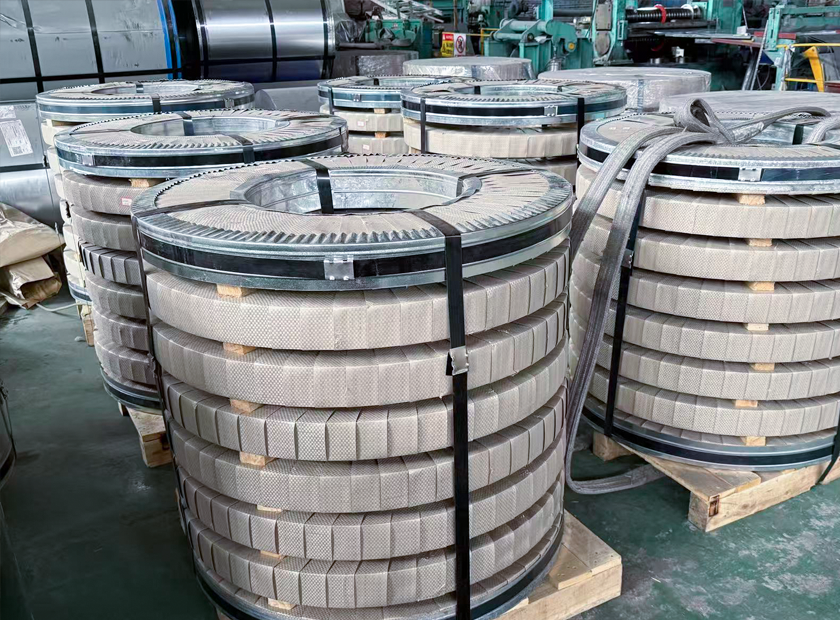
Electrical steel supply form. Coating type and insulation performance must be confirmed through product documentation.
Coating Classes Are Not Complete Specifications
Designations such as C-3 and C-5 describe coating classifications rather than a universal quality ranking. The applicable classification system and the supplier's exact coating designation should be identified.
ASTM A976 classifies electrical steel insulating coatings by composition, relative insulating ability and application. Its classification does not provide specific surface insulation resistivity values for every coating.
Ask for the actual product data instead of assuming that materials with the same class designation have identical insulation, corrosion or processing performance.
How Electrical Steel Coatings Affect Welding
Match the Coating to the Joining Method
Some lamination stacks are welded, while others are interlocked, clamped, riveted or bonded. These assembly methods place different demands on the coating.
Coating composition and thickness can influence weld consistency. A material selected primarily for insulation or punchability should not automatically be approved for a welded stack.
Producer-specific data illustrate this distinction. Thyssenkrupp's insulation-coating technical information lists different combinations of insulation, weldability, corrosion protection and temperature resistance for its coating products.
Validate the Complete Welded Stack
Qualify welding with representative material, stack geometry and the intended joining process. Check weld quality, stack integrity and the effect on the finished core.
Welding creates local electrical connections and introduces heat. A coating described as weldable does not mean that the resulting core is free from additional electrical or magnetic effects.
Agree any local coating preparation with the material supplier and welding engineer. Do not remove insulation from broad areas without understanding the effect on the core design.
How Coatings Behave During Annealing
Separate Service Temperature from Annealing Conditions
A coating's continuous operating-temperature rating and its ability to survive an annealing cycle are different properties.
Annealing compatibility depends on peak temperature, holding time, atmosphere, heating and cooling conditions, and the required coating condition afterwards. A short exposure limit should not be interpreted as a continuous-service rating.
As an example of product-specific guidance, voestalpine's insulating varnish information distinguishes organic insulation systems from inorganic/organic systems with different processing capabilities. Those published conditions apply to its stated products, not automatically to another supplier's coating.
Review the Material and Coating Together
The steel grade must also permit the proposed heat treatment. Fully processed and semi-processed non-oriented steels have different intended processing routes.
For grain-oriented material, review the complete coating system and any domain-refinement treatment. A coating that tolerates heat does not prove that every other material feature will retain its original performance after annealing.
Check insulation, adhesion and appearance after a representative furnace cycle. Where relevant, verify magnetic performance and whether laminations separate as required.
There is no universal annealing temperature suitable for every electrical steel coating. Obtain instructions for the exact grade and coating combination.
Corrosion Resistance and Practical Coating Selection
Coated Surfaces and Cut Edges Need Different Attention
A coating may provide corrosion protection to the coated faces, but slitting and punching expose fresh steel at the edges. Scratches and damaged areas can also become vulnerable during storage and handling.
Request corrosion-test information with the test method, exposure conditions, duration and acceptance criteria. A general description such as "corrosion resistant" does not establish suitability for outdoor service or a particular storage period.
Packaging Complements the Coating
Moisture protection during transport and storage remains important even when the material has an insulating coating. Condensation, trapped moisture and damaged packaging can create conditions that were not represented by a coating test.
Confirm wrapping, edge protection and storage instructions through the supplier's electrical steel packaging and supply services. Keep transport packaging separate from the specification for the coating on each lamination.
Coil transport packaging complements material protection. It is separate from the insulating coating on the steel surface.
Use a Process-Based Purchasing Specification
Describe the complete route from incoming coil to finished core. Include cutting, lubricants, cleaning, joining, heat treatment and expected storage conditions.
Requirement
What to Confirm
Material identity
Steel grade, thickness and delivery condition
Coating identity
Supplier designation, classification, coated sides and thickness basis
Insulation
Required value, test method and condition before or after processing
Joining
Welding, interlocking, clamping or bonding requirements
Heat treatment
Approved cycle and required properties after treatment
Corrosion protection
Exposure conditions, test evidence, edge condition and packaging
Qualify representative samples through the intended route before approving a coating for production. Colour and surface appearance alone cannot establish its chemistry or performance.
Frequently Asked Questions
1. Does a higher coating classification number mean better insulation?
No. Coating classifications describe material categories and applications. Compare the actual insulation data and test conditions rather than treating the number as a quality score.
2. Can all coated electrical steel be welded?
No. Confirm the coating's suitability for the intended joining process and validate representative stacks. A weldable coating does not eliminate the need to assess the finished core.
3. Can a heat-resistant coating withstand stress-relief annealing?
Not automatically. Service-temperature resistance and annealing compatibility are different. Confirm the complete furnace cycle, atmosphere and required properties after treatment.
4. Does an insulating coating prevent rust on cut edges?
Do not assume so. Cutting exposes steel that may not have the same protection as the coated faces. Handling, storage and packaging remain important.
5. Should I choose the thickest available coating?
No. Select a coating that meets insulation and processing requirements while respecting stacking factor and dimensional limits. Greater thickness is not a universal improvement.
Discuss Electrical Steel Coating Requirements with SHERAXIN
Share your steel grade, core application, joining method and planned heat treatment with SHERAXIN. Include insulation and storage requirements so the material and coating can be reviewed together.
Contact SHERAXIN to discuss suitable electrical steel supply options and the technical information needed for sample evaluation.