Cold Rolled Grain Oriented (CRGO) steel is a specialized type of electrical steel renowned for its exceptional magnetic properties. With its high magnetic permeability and low core losses, CRGO steel is primarily used in transformer cores, significantly enhancing their efficiency and performance. This article delves into the unique characteristics, manufacturing processes, applications, and future prospects of CRGO steel, highlighting its vital role in modern electrical engineering.
Properties of CRGO Steel
Cold Rolled Grain Oriented (CRGO) steel is a special type of electrical steel known for its excellent magnetic properties. These properties make it ideal for use in transformer cores and other electrical equipment. Let’s explore its key characteristics.
Magnetic Permeability
CRGO steel has very high magnetic permeability. This means it allows magnetic lines of force to pass through it easily. High permeability helps transformers operate efficiently because the magnetic core can channel magnetic flux with minimal resistance. The grain orientation during manufacturing aligns the crystal structure in the rolling direction, enhancing this effect. This alignment, called Goss texture, makes the steel magnetize easily along that direction, reducing energy needed to magnetize the core.
Electrical Resistivity
Electrical resistivity is the ability of a material to resist electrical current. CRGO steel has high electrical resistivity compared to regular steel. This is mainly due to the silicon content added during production. High resistivity reduces eddy current losses inside the transformer core. Eddy currents are loops of electrical current induced inside the steel by changing magnetic fields, which cause energy loss and heat. By resisting these currents, CRGO steel improves transformer efficiency and reduces heat generation.
Low Losses and High Efficiency
One of the most important reasons CRGO steel is used in transformers is its low core losses. Core losses include hysteresis loss and eddy current loss. Hysteresis loss happens because the magnetic domains inside the steel resist changes in magnetization. CRGO steel’s grain orientation and high purity reduce this resistance. Eddy current losses, as mentioned, are minimized by the steel’s high resistivity and thin lamination sheets.
Together, these factors lead to significantly lower energy losses in transformers. This means transformers using CRGO steel waste less electricity, run cooler, and last longer. The high stacking factor of CRGO sheets also allows manufacturers to build compact, efficient cores.
Summary of Key Properties
Property | Description | Benefit |
High Magnetic Permeability | Easy magnetization along rolling direction | Efficient magnetic flux conduction |
High Electrical Resistivity | Resists eddy currents inside core | Lower energy loss, less heat |
Low Core Losses | Reduced hysteresis and eddy current losses | Higher transformer efficiency |
High Stacking Factor | Thin laminations packed tightly | Compact core design, material saving |
These properties make CRGO steel the preferred choice for transformer cores and other electrical devices where efficiency and energy savings matter.
To maximize transformer efficiency, choose CRGO steel grades with optimized grain orientation and high silicon content, reducing core losses and improving magnetic performance.
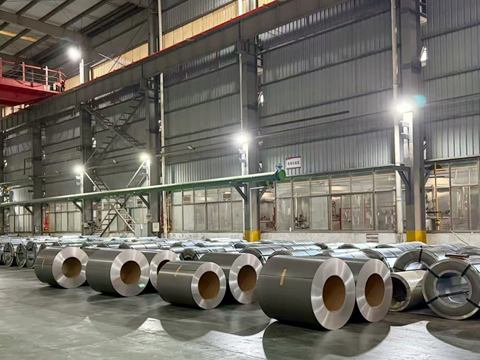
Manufacturing Process of CRGO
Cold Rolled Grain Oriented (CRGO) steel owes its unique magnetic properties to a carefully controlled manufacturing process. This process aligns the grains in a specific direction, improving magnetic performance and reducing energy losses. Let’s break down the key steps involved in making CRGO steel.
Cold Rolling Process
The first major step is cold rolling. After the steel is initially hot rolled into thin sheets, it undergoes cold rolling to further reduce thickness, usually between 0.1 mm and 0.5 mm. Cold rolling is done at room temperature, which increases the steel’s strength and refines its grain structure.
This step is crucial because it helps create the grain orientation known as the Goss texture. The grains align along the rolling direction, which is the direction of easy magnetization. This alignment is what gives CRGO steel its high magnetic permeability in one direction, making it ideal for transformer cores.
Annealing and Grain Orientation
After cold rolling, the steel sheets undergo annealing — a heat treatment process. Annealing is done in a controlled atmosphere to prevent oxidation and to allow the grains to grow and orient properly.
During annealing, the steel is heated to a temperature around 800 to 900°C and then cooled slowly. This heat treatment helps develop the Goss texture fully, enhancing magnetic properties. It also reduces internal stresses caused by rolling, which can otherwise increase energy losses.
Sometimes, a secondary annealing step called stress relief annealing is performed after cutting the steel into laminations. This step further improves magnetic performance by releasing residual stresses from cutting and shaping.
Surface Finishing Techniques
The surface finish of CRGO steel is another important factor. After annealing, the steel sheets receive a thin coating, often an insulating oxide or organic layer. This coating reduces eddy current losses by electrically insulating the laminations from one another.
The surface must be smooth and free of defects to avoid losses and improve durability. Some manufacturers apply a phosphate or oxide coating that also helps protect against corrosion.
The laminations are then cut or stamped into the required shapes for transformer cores. Careful handling during this stage ensures the grain orientation isn't damaged, preserving the steel’s magnetic advantages.
To maintain CRGO steel’s superior magnetic properties, ensure precise control of cold rolling thickness and annealing temperatures, and apply high-quality insulating coatings to minimize eddy current losses.
Applications of CRGO Steel
Cold Rolled Grain Oriented (CRGO) steel plays a key role in many electrical devices thanks to its unique magnetic properties. Its main use is in transformer cores, but it also shines in high voltage equipment and other electrical applications. Let’s explore these uses in detail.
Use in Transformer Cores
The most common application of CRGO steel is in transformer cores. Transformers rely on magnetic cores to efficiently transfer electrical energy between coils. CRGO steel’s high magnetic permeability and low core losses make it perfect for this.
Transformer cores are built from thin laminations of CRGO steel stacked or wrapped around coils. This layering reduces eddy current losses and improves efficiency. The grain orientation in CRGO steel lets magnetic flux flow easily along the rolling direction, minimizing energy wasted as heat.
Thanks to these properties, transformers using CRGO steel consume less power, run cooler, and last longer. This is especially important for power transformers and distribution transformers, which operate continuously and handle large amounts of electricity.
Advantages in High Voltage Equipment
CRGO steel is also valuable in high voltage electrical equipment. Devices like reactors, inductors, and large electrical machines benefit from CRGO’s magnetic efficiency and low losses.
High voltage equipment often faces strong magnetic fields and high electrical stresses. CRGO steel’s high electrical resistivity reduces eddy current losses, helping to maintain performance and reliability. Its grain orientation ensures magnetic flux moves efficiently, reducing noise and vibration caused by magnetostriction.
Moreover, CRGO steel’s corrosion resistance and mechanical strength contribute to the durability of high voltage components, improving their lifespan and reducing maintenance costs.
Other Electrical Applications
Beyond transformers and high voltage gear, CRGO steel finds use in other electrical devices requiring efficient magnetic cores. These include:
● Chokes and Inductors: CRGO steel cores help reduce energy losses in power electronics and filtering circuits.
● Magnetic Sensors: The steel’s sensitivity to magnetic fields improves sensor accuracy.
● Electric Motors: Though non-grain oriented steel is more common here, some specialized motors use CRGO steel for parts requiring directional magnetic properties.
The versatility of CRGO steel makes it a preferred choice wherever magnetic efficiency and energy savings are priorities.
When designing transformers or high voltage equipment, select CRGO steel grades with optimal grain orientation and high silicon content to maximize energy efficiency and reduce operational losses.
Comparison with Other Electrical Steels
When choosing materials for electrical applications, especially transformer cores, it’s important to understand how CRGO steel compares to other electrical steels. We’ll look at differences between grain oriented and non-grain oriented steels, compare CRGO with amorphous metal alloys, and review key performance metrics.
Grain Oriented vs Non-Grain Oriented Steel
Grain Oriented (GO) steel, like CRGO, has grains aligned in one direction. This alignment maximizes magnetic permeability along the rolling direction, making it ideal for transformers where magnetic flux flows mainly in one direction. The Goss texture in CRGO steel enables low core losses and high efficiency.
Non-Grain Oriented (NGO) steel has randomly oriented grains. It offers more uniform magnetic properties in all directions. This makes NGO steel better suited for rotating machines such as motors and generators, where magnetic fields constantly change direction. However, NGO steels typically have higher core losses and lower permeability compared to GO steels.
In short:
Feature | Grain Oriented (CRGO) | Non-Grain Oriented (NGO) |
Grain Direction | Aligned (Goss texture) | Random |
Magnetic Permeability | High in rolling direction | Moderate, uniform in all directions |
Core Losses | Low | Higher than GO |
Typical Applications | Transformers, inductors | Motors, generators |
CRGO vs Amorphous Metal Alloys
Amorphous metal alloys are an alternative to CRGO steel. They have a non-crystalline structure, which leads to even lower core losses than CRGO steel. These alloys can reduce energy losses by 20-30% compared to CRGO steel in transformers, making them very attractive for energy-efficient designs.
However, amorphous metals come with challenges:
● They are more brittle and harder to handle.
● Manufacturing processes are more complex and costly.
● Lamination thickness is often thinner, requiring special stacking and insulation.
CRGO steel remains popular due to its balance of good magnetic properties, mechanical strength, and cost-effectiveness. Amorphous alloys are typically used in specialized or high-efficiency transformers where cost is less of a concern.
Performance Metrics
When comparing electrical steels, several key metrics matter:
● Core Losses (W/kg): Lower is better. CRGO steel typically has losses around 0.5 to 1.0 W/kg at 1.5 Tesla and 50/60 Hz. Amorphous alloys can achieve losses as low as 0.2 W/kg.
● Magnetic Permeability: Higher permeability means easier magnetization and better efficiency. CRGO steel’s permeability can be 3000 to 5000, much higher than NGO steel.
● Electrical Resistivity: Higher resistivity reduces eddy currents and losses. CRGO steel’s silicon content boosts resistivity above normal steel.
● Mechanical Strength: CRGO steel offers good strength for handling and fabrication. Amorphous alloys are more fragile.
Choosing the right material depends on application requirements, cost constraints, and efficiency goals.
For transformer cores requiring maximum efficiency and low losses, select CRGO steel for cost-effective performance or consider amorphous metal alloys when ultra-low losses justify higher costs.
Future of CRGO Steel
Cold Rolled Grain Oriented (CRGO) steel has been a cornerstone material in electrical engineering for decades. Its magnetic and electrical properties make it ideal for transformer cores and other electrical devices. Yet, the future of CRGO steel is shaped by ongoing research, potential improvements, and market demands. Let’s explore these aspects in detail.
Research and Development
Researchers continue to study CRGO steel to push its performance boundaries. One key focus is optimizing silicon content. Silicon improves electrical resistivity and reduces losses, but too much can make the steel brittle. Finding the perfect balance enhances efficiency without sacrificing mechanical strength.
Advanced annealing techniques are also under development. Precise control of temperature and atmosphere during annealing can improve grain orientation, leading to better magnetic properties. New coating materials are being tested to reduce eddy current losses further and protect the steel from corrosion.
Additionally, scientists explore alloying CRGO steel with other elements like aluminum or nitrogen to tweak magnetic and mechanical characteristics. These efforts aim to produce steels that offer higher permeability, lower losses, and better durability.
Potential Improvements
Several improvements could make CRGO steel even more effective:
● Lower Core Losses: By refining the grain structure and surface coatings, manufacturers can reduce hysteresis and eddy current losses further. This results in transformers that waste less energy and run cooler.
● Thinner Laminations: Producing thinner steel sheets without losing mechanical strength can improve stacking factors. This allows more compact transformer cores, saving space and materials.
● Enhanced Corrosion Resistance: New coatings or alloy compositions can extend the lifespan of CRGO steel in harsh environments, reducing maintenance costs.
● Cost Efficiency: Improving manufacturing processes to reduce scrap and energy use lowers production costs, making CRGO steel more affordable.
Market Trends and Demand
The demand for energy-efficient electrical equipment drives CRGO steel’s market growth. Governments and industries worldwide aim to reduce energy losses in power distribution, increasing reliance on high-quality transformer cores.
Renewable energy systems like wind and solar power require reliable transformers, often benefiting from CRGO steel’s properties. The rise of electric vehicles and smart grids also boosts demand for efficient electrical steels.
However, competition from alternative materials like amorphous metal alloys continues. These alloys offer even lower core losses but at higher costs and with handling challenges. CRGO steel remains popular due to its balance of performance, cost, and mechanical robustness.
Manufacturers are investing in sustainable production methods, responding to environmental concerns. Recycling CRGO steel and reducing carbon footprints during production are becoming priorities.
Stay updated on advances in silicon optimization and annealing techniques to select CRGO steel grades that deliver improved efficiency and reliability for next-generation electrical equipment.
Conclusion
CRGO steel, known for its high magnetic permeability and low core losses, is pivotal in transformer cores and high voltage equipment. It enhances efficiency, reduces energy waste, and extends equipment lifespan. As the electrical industry evolves, CRGO steel's role remains vital, with ongoing research promising further improvements. Wuxi Sheraxin Electrical Steel Co., Ltd. offers premium CRGO steel products, ensuring top performance and reliability, meeting the growing demand for energy-efficient solutions in the market.
FAQ
Q: What is CRGO steel?
A: CRGO steel, or Cold Rolled Grain Oriented steel, is a type of electrical steel known for its high magnetic permeability and low core losses, making it ideal for transformer cores.
Q: How is CRGO steel used in transformers?
A: CRGO steel is used in transformer cores due to its ability to efficiently channel magnetic flux, reducing energy losses and improving overall efficiency.
Q: Why is CRGO steel preferred over other steels?
A: CRGO steel is preferred for its optimized grain orientation, which allows easy magnetization, leading to higher efficiency and reduced energy losses in electrical applications.


