

close
Choose Your Site
Global
Social Media
Views: 0 Author: Site Editor Publish Time: 2026-08-04 Origin: Site


Globalized supply chains require manufacturers of motors, transformers, and generators to source materials across multiple regions, necessitating strict cross-referencing of international material standards. Relying on nominal grade equivalents without verifying the underlying magnetic and physical properties—such as core loss, permeability, and thickness—leads to catastrophic efficiency drops, excessive heat generation, or mechanical failure during stamping operations.
Navigating the technical nuances between ASTM, IEC, EN, JIS, GB, and emerging standards like India’s BIS (IS) is critical for procurement engineering. A mismatch in testing frequencies or coating specifications can compromise an entire production run. This guide provides a definitive framework for evaluating and cross-referencing global Electrical Steel grades to ensure exact performance equivalency and mitigate sourcing risks.

Standardization Baselines Differ: ASTM standards typically evaluate core loss at 60 Hz (North American standard), while IEC, EN, JIS, GB, and IS standards evaluate at 50 Hz, requiring mathematical conversion for accurate equivalency.
Nomenclature Reveals Performance: Most global standards (EN, JIS, GB) encode the maximum core loss and nominal thickness directly into the grade designation (e.g., M270-50A indicates 2.70 W/kg at 0.50mm).
Mill Brands vs. National Standards: High-performance designs often reference proprietary commercial grades (e.g., JFE's JN series or Nippon Steel's specialty sheets) which must be systematically decoded back to standardized ASTM or IEC equivalents.
Coating Equivalency is Critical: Matching the base steel grade is insufficient; insulation coatings (e.g., ASTM C-5 vs. IEC EC-5) must also align to prevent interlaminar short circuits.
Verification is Mandatory: "Equivalent" does not mean "identical." Mill Test Certificates (MTCs), density assumption checks, and Epstein frame testing are required to validate magnetic properties before bulk procurement.
Table of Contents
Defining what constitutes an equivalent grade in machine design requires matching core loss, magnetic induction, thickness, and mechanical hardness. Engineers must establish fundamental industrial classifications before cross-referencing. Cold-Rolled Non-Grain-Oriented (CRNGO) materials serve rotating machinery like motors and generators. Cold-Rolled Grain-Oriented (CRGO) materials support static transformers where magnetic flux travels in a single preferred direction.
Regional frameworks evolved independently before aligning with international IEC 60404 benchmarks. European (EN/DIN), Japanese (JIS), Chinese (GB/T), Indian (IS), Russian (GOST), and American (ASTM) standards interact differently with these global baselines. The most significant divergence lies in testing methodologies. North American standards test magnetic properties at 60 Hz. The rest of the world tests at 50 Hz. You cannot directly compare a 60 Hz core loss value to a 50 Hz value without applying specific conversion factors based on the material's thickness and alloy composition.
To establish a true equivalency framework, engineering teams must evaluate several core parameters beyond just the basic grade name. A simple cross-reference chart often misses the subtle metallurgical differences that dictate how a material behaves under load. We look at specific success criteria when validating an alternative material source.
Maximum core loss at the target operating induction (usually 1.5T or 1.7T).
Minimum magnetic polarization at specific magnetic field strengths (e.g., 2500 A/m, 5000 A/m, 10000 A/m).
Stacking factor and lamination factor, which dictate how much active magnetic material fits into a given core volume.
Mechanical properties including yield strength, tensile strength, and Vickers hardness, which directly impact die wear during stamping.
Insulation coating type, thickness, and thermal resistance.
When evaluating CRNGO versus CRGO, the terminology across regions can sometimes blur. CRNGO is engineered to have isotropic magnetic properties, meaning it performs relatively equally in all directions. This makes it ideal for the rotating magnetic fields found in electric motors. CRGO is processed to align the crystal structure of the silicon steel in the rolling direction, providing vastly superior magnetic properties in that single direction, which is perfect for the stationary flux paths in transformers.
Material Type | Primary Application | Magnetic Properties | Typical Silicon Content |
|---|---|---|---|
CRNGO (Non-Oriented) | Motors, Generators, Alternators | Isotropic (Equal in all directions) | 0.5% to 3.2% |
CRGO (Grain-Oriented) | Power Transformers, Distribution Transformers | Anisotropic (Highly directional) | 3.0% to 3.5% |
The testing frequency discrepancy remains the largest hurdle in global procurement. North American grids operate at 60 Hz, so ASTM standards naturally evaluate core loss at this frequency. European and Asian grids operate at 50 Hz. Because core loss increases non-linearly with frequency due to eddy current and hysteresis effects, a material rated at 1.50 W/kg at 50 Hz will exhibit a significantly higher loss—often around 1.95 to 2.10 W/kg—when tested at 60 Hz. Procurement engineers must use empirical conversion formulas or request specific 50/60 Hz test data from the mill to ensure the Electrical Steel meets the design requirements.
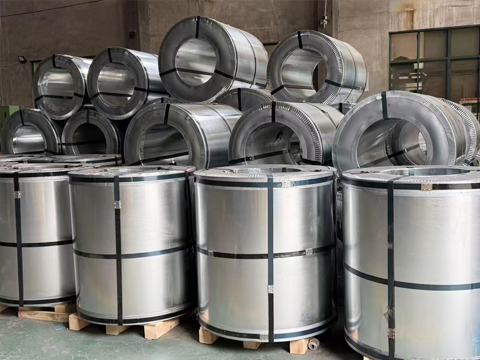
North American procurement relies heavily on ASTM specifications. ASTM A677 covers fully processed non-oriented materials. ASTM A683 dictates requirements for semi-processed non-oriented variants. ASTM A876 governs grain-oriented grades used in power distribution. These specifications dictate both the testing parameters and the acceptable physical tolerances for domestic mills.
ASTM nomenclature differs significantly from international counterparts. A designation like 47F165 breaks down into specific imperial metrics. The "47" represents the nominal thickness in thousandths of an inch (0.047 inches). The "F" indicates a fully processed material. The "165" specifies the maximum core loss limit of 1.65 W/lb tested at 1.5 Tesla and 60 Hz. When sourcing internationally, engineers must recalculate these ASTM core loss values from W/lb at 60 Hz to W/kg at 50 Hz to find suitable IEC or EN equivalents.
Fully processed materials (ASTM A677) arrive from the mill with their magnetic properties fully developed. The manufacturer simply stamps the laminations and assembles the core. Semi-processed materials (ASTM A683) require a final stress-relief annealing process after stamping to achieve their rated magnetic properties. This annealing step removes the mechanical stresses introduced during the punching process, which would otherwise degrade the magnetic performance.
ASTM Grade Example | Thickness (inch/mm) | Max Core Loss (W/lb @ 60Hz) | Approximate 50Hz Equivalent (W/kg) |
|---|---|---|---|
36F145 | 0.036" / 0.91mm | 1.45 | ~2.50 |
47F165 | 0.047" / 1.19mm | 1.65 | ~2.85 |
64F200 | 0.064" / 1.63mm | 2.00 | ~3.45 |
Grain-oriented materials under ASTM A876 follow a slightly different naming convention. A grade like 27G051 indicates a thickness of 0.0106 inches (0.27 mm), "G" for grain-oriented, and a maximum core loss of 0.51 W/lb at 1.5T and 60 Hz. The testing for these materials relies heavily on the Epstein frame method, which measures the magnetic properties of standardized rectangular strips cut from the coil. The Epstein test remains the gold standard for validating mill test certificates against ASTM requirements.
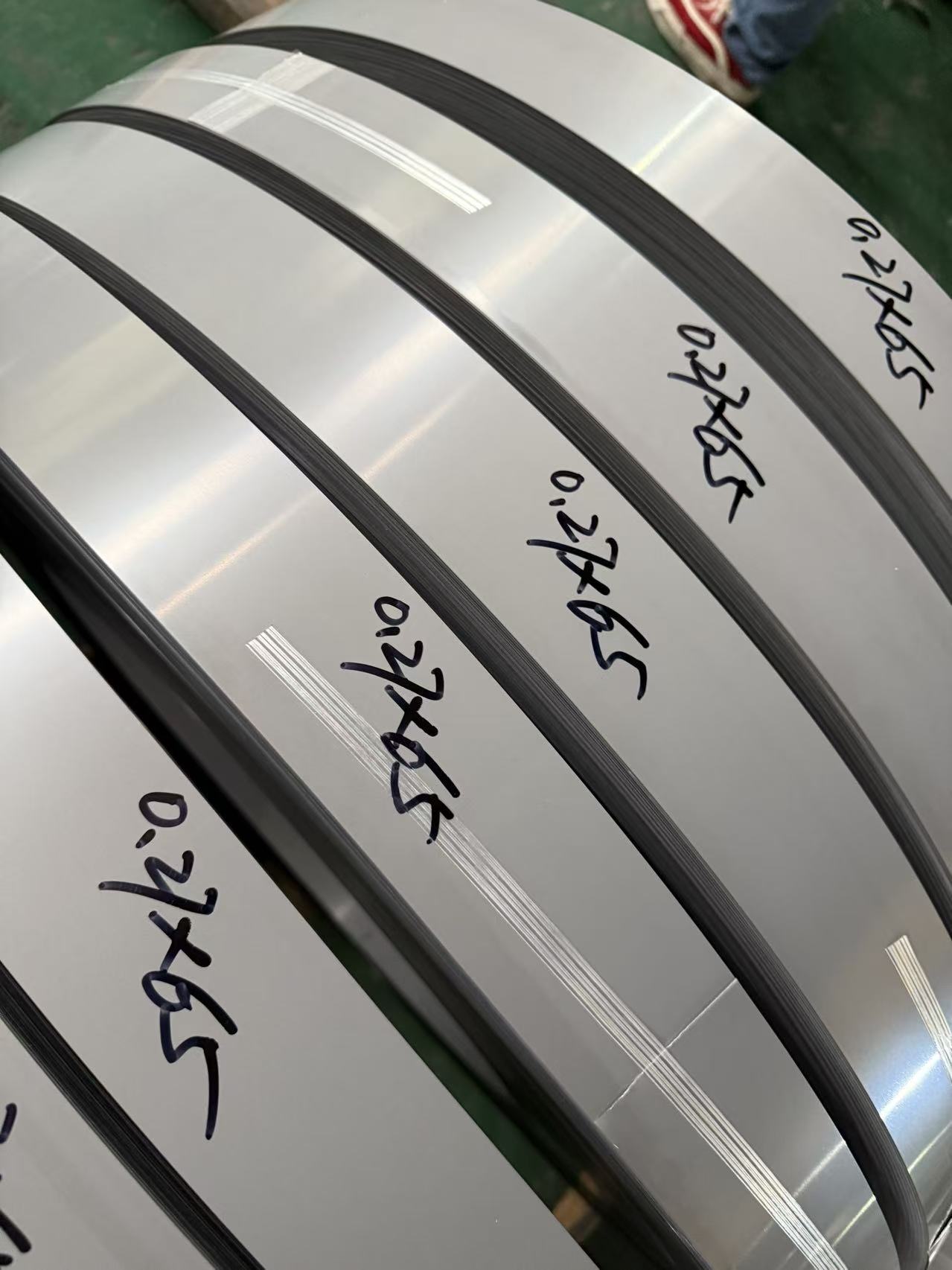
European and international markets utilize EN 10106 and IEC 60404-8-4 for non-oriented grades. Grain-oriented materials fall under EN 10107 and IEC 60404-8-7. These standards form the baseline for most global manufacturing outside North America. They provide a clear, metric-based nomenclature system that directly communicates the material's physical and magnetic capabilities.
Decoding the European naming convention reveals exact performance metrics. Take the grade M330-50A as an example. The "M" stands for magnetic steel. The "330" indicates a maximum specific total loss of 3.30 W/kg tested at 1.5 Tesla and 50 Hz. The "50" represents a nominal thickness of 0.50 mm. The "A" signifies a non-oriented, fully processed sheet. Legacy German DIN standards, such as DIN 46400, still appear on older blueprints. You must map these historical designations to modern EN/IEC equivalents to ensure current supply chain compatibility.
The IEC 60404 series is extensive, covering not just material specifications but also the exact testing methodologies required to validate them. IEC 60404-2 defines the Epstein frame testing procedures, ensuring that a mill in Germany and a mill in South Korea use the exact same physical setup to measure core loss and permeability. This standardization is what allows procurement teams to confidently source materials globally.
EN/IEC Grade | Thickness (mm) | Max Core Loss (W/kg @ 50Hz, 1.5T) | Min Polarization (Tesla @ 5000 A/m) |
|---|---|---|---|
M230-35A | 0.35 | 2.30 | 1.60 |
M270-50A | 0.50 | 2.70 | 1.60 |
M330-50A | 0.50 | 3.30 | 1.60 |
M400-65A | 0.65 | 4.00 | 1.60 |
When dealing with grain-oriented materials under EN 10107, the nomenclature shifts slightly. A grade like M140-30S indicates a maximum core loss of 1.40 W/kg at 1.7 Tesla and 50 Hz, a thickness of 0.30 mm, and "S" for conventional grain-oriented material. High-permeability grades use "P" instead of "S", denoting materials that have been processed to achieve even sharper crystal alignment, resulting in lower losses and higher induction levels. These high-permeability grades are essential for meeting stringent energy efficiency regulations in modern transformer designs.
Japanese industrial standards maintain strict alignment with IEC methodologies while supporting some of the world's most advanced proprietary mill capabilities. JIS C 2552 governs non-oriented sheets, while JIS C 2553 covers grain-oriented production. The JIS nomenclature format shares direct structural similarities with IEC standards, making cross-referencing relatively straightforward for baseline materials.
A standard JIS designation like 50A290 indicates a 0.50 mm thickness ("50"), fully processed non-oriented status ("A"), and a maximum core loss of 2.90 W/kg at 50 Hz ("290"). However, market reality often deviates from standard designations. Japanese mills like JFE Steel and Nippon Steel dominate the high-efficiency, thin-gauge market. Engineers frequently encounter proprietary commercial series, such as JFE's JN, JNP, or JN-H grades. You must systematically map these proprietary designations back to standard JIS or ASTM benchmarks using the mill's specific technical data sheets.
The proprietary grades developed by Japanese mills often push the boundaries of what is possible within the standard JIS framework. For example, standard JIS C 2552 might top out at a certain core loss for a 0.35 mm thickness, but a proprietary grade from Nippon Steel might offer a 10% to 15% reduction in core loss at that same thickness. This is achieved through advanced metallurgical control, optimizing the silicon and aluminum content, and employing highly specialized rolling and annealing techniques.
JIS Grade | Thickness (mm) | Max Core Loss (W/kg @ 50Hz, 1.5T) | Equivalent EN Grade |
|---|---|---|---|
35A230 | 0.35 | 2.30 | M230-35A |
50A290 | 0.50 | 2.90 | M290-50A |
50A470 | 0.50 | 4.70 | M470-50A |
When sourcing from Japan, it is also critical to understand their coating designations. JIS specifies various insulation coatings, often categorized by their composition (organic, inorganic, or semi-organic) and their intended application (punchability, weldability, or high-temperature resistance). Ensuring that the JIS coating aligns with the required ASTM or IEC coating specification is just as important as matching the magnetic properties. A mismatch here can lead to severe interlaminar shorting and core failure.

Chinese manufacturing relies on the GB/T standardization framework. GB/T 2521.1 specifies requirements for non-oriented materials. GB/T 2521.2 covers grain-oriented production. The Chinese nomenclature system directly mirrors IEC thickness and core loss metrics, facilitating easier international trade and material substitution.
A typical Chinese grade like 50W310 breaks down logically. The "50" denotes a 0.50 mm thickness. The "W" indicates non-oriented Electrical Steel. The "310" represents a maximum core loss of 3.10 W/kg at 50 Hz. Implementation realities require careful supplier vetting. Consistency varies significantly between Tier 1 Chinese mills, such as Baosteel or WISCO, and smaller Tier 2 or Tier 3 producers. Procurement teams must manage variations in magnetic aging limits and dimensional tolerances specified under the broader GB/T umbrella.
Magnetic aging is a critical factor when evaluating GB/T materials. Aging refers to the degradation of magnetic properties over time, typically caused by the precipitation of carbon and nitrogen impurities within the steel matrix. Tier 1 mills employ advanced vacuum degassing techniques to reduce these impurities to negligible levels, ensuring the material remains non-aging. However, materials from lower-tier mills might exhibit significant aging, leading to increased core losses and higher operating temperatures in the field after several months of use.
GB/T Grade | Thickness (mm) | Max Core Loss (W/kg @ 50Hz, 1.5T) | Typical Application |
|---|---|---|---|
35W250 | 0.35 | 2.50 | High-efficiency motors |
50W310 | 0.50 | 3.10 | Standard industrial motors |
50W470 | 0.50 | 4.70 | Small appliances, fractional HP motors |
65W600 | 0.65 | 6.00 | Low-cost, low-duty cycle applications |
Dimensional tolerances also require strict oversight when sourcing under GB/T standards. Crown (the difference in thickness between the center and the edges of the coil) and edge drop must be tightly controlled to ensure a high stacking factor. Excessive crown leads to loose cores, increased vibration, and higher acoustic noise in the final machine. Always request detailed dimensional inspection reports alongside the standard magnetic test data when qualifying a new GB/T supplier.
The Indian market operates under the Bureau of Indian Standards (BIS). IS 648 dictates specifications for CRNGO materials. IS 3024 governs CRGO materials. The Indian nomenclature follows a similar metric pattern to Europe and China. A grade like 50C350 indicates a 0.50 mm thickness ("50"), standard core loss category ("C"), and a maximum loss of 3.50 W/kg ("350").
Importing materials into the Indian manufacturing market requires strict adherence to the BIS certification framework. Foreign mills must obtain mandatory BIS certification to supply the Indian market. Equivalency on paper does not bypass this legal requirement. Procurement teams must verify both the technical equivalency of the material and the active BIS certification status of the producing mill to avoid customs rejections and supply chain disruptions.
The BIS certification process is rigorous. It involves factory audits by Indian inspectors, extensive material testing at BIS-approved laboratories, and continuous compliance monitoring. This ensures that materials entering the Indian market meet strict quality and safety standards. For global manufacturers setting up production facilities in India, navigating this certification landscape is just as critical as managing the technical specifications of the steel itself.
IS Grade (CRNGO) | Thickness (mm) | Max Core Loss (W/kg @ 50Hz, 1.5T) | Equivalent IEC Grade |
|---|---|---|---|
35C250 | 0.35 | 2.50 | M250-35A |
50C350 | 0.50 | 3.50 | M350-50A |
65C530 | 0.65 | 5.30 | M530-65A |
When cross-referencing IS standards with other global frameworks, engineers must also pay attention to the specific testing conditions outlined in IS 648 and IS 3024. While they generally align with IEC 60404, there can be minor variations in sample preparation or testing equipment calibration requirements. Always rely on the actual Mill Test Certificate data rather than assuming perfect alignment based solely on the grade designation.
With more than 20 years of experience in the electrical steel market and over 16 years of manufacturing expertise, SHERAXIN supplies CRGO and CRNGO coils, strips, and sheets for transformer cores and electrical laminations. Supported by customized production capabilities and an established international supply network, the company helps global customers source electrical steel products that meet different magnetic, dimensional, processing, and delivery requirements.
Request complete Mill Test Certificates (MTCs) for every batch to verify actual core loss and permeability against the nominal standard requirements.
Apply the correct mathematical conversion factors when cross-referencing North American 60 Hz data with international 50 Hz specifications.
Validate insulation coating compatibility alongside base metal properties to prevent interlaminar shorting in stacked cores.
Audit Tier 2 and Tier 3 international mills specifically for magnetic aging compliance and gauge consistency across coil widths.
Verify active BIS certification status for any mill supplying materials destined for the Indian manufacturing market.
A: Direct substitution requires recalculating core loss values. ASTM tests at 60 Hz, while EN tests at 50 Hz. You must apply a conversion factor based on thickness and alloy to ensure true magnetic equivalency before substituting.
A: In EN nomenclature, the "A" indicates that the material is a non-oriented, fully processed steel sheet ready for stamping and stacking without additional annealing.
A: Proprietary grades from mills often exceed national standard minimums. They may offer tighter thickness tolerances, lower core losses, or specialized coatings not explicitly defined in standard JIS or GB/T frameworks.
A: Yes. The Bureau of Indian Standards mandates that all imported electrical steel must come from a BIS-certified mill. Technical equivalency alone is insufficient for customs clearance.
A: Insulation coatings prevent electrical currents from jumping between stacked laminations. If you substitute a grade but use an inferior or incompatible coating, the resulting interlaminar short circuits will cause severe overheating and efficiency loss.


